
THE GREAT NAMIBIAN ROADTRIP
INTRO
Have wheels, will travel. As the second-least densely populated country in the world (after our beloved Mongolia), it is rather challenging to get around Namibia without a car. Likewise, public transit lines tend to connect cities and towns, not the nature reserves and parks that tend to attract most outside visitors. That being said, buckle in for the roadtrip of a lifetime. We spent a little over a month all across Namibia in September 2022 and while it was quite a bit of time, it wasn't enough!
WHAT YOU NEED TO KNOW
Duration: The more time, the better. We met travelers roadtripping around the country from anywhere from one week to over a month. If you can make it work, we'd recommend at least 2 weeks. Regardless of how much time you can take, just don't trust the times on Google Maps. It usually doesn't account for the fact that much of the driving is on dirt roads, so travel times will likely be slower than what it says.
When to go: Namibia is known to be a great destination year-round, with good temperatures and sunny weather. We took our monthlong roadtrip in September.
Accommodations + facilities: There are two ways to house (or home) yourself in Namibia if you're exploring its natural sites: 1) lodge/safari tent or 2) your own tent. Of course, lodges and safari tents are more comfortable, but the price reflects what you're paying for. Often, campsites have bathrooms and nice enough shared facilities. Regardless of where you stay, book at least a few weeks out, especially for the country's most popular destinations (e.g., Etosha, the dunes at Namib-Naukluft National Park).
We opted to camp, and there are essentially two styles of driving/camping, based on your budget:
Renting a 4x4 with a built-in rooftop tent: more expensive but easier and sturdier than your average tent
Renting a normal 4x4 car with a freestanding tent: less expensive but let us know if you figure out a better way than we did to camp in a sandstorm
Note that, almost all campsites are paid, and in a few places, there were little to no camping options, such as in Skeleton Coast National Park.
Food + water: ALWAYS carry extra food and water, and stock up on groceries in Windhoek and when you pass through cities and towns. Many campsites/lodges have restaurants, cafés, and provisions stores on site, but it's not a guarantee. We cooked a lot using our camp stove, and note you can find camping fuel at a few stores in Windhoek. We picked ours up at Outdoor Warehouse in the Grove Mall and Bushwhackers Windhoek (though we recommend calling before to make sure they have it).
Guide or no guide: It is not uncommon to hire a driver/guide around Namibia, but given the routes are pretty straightforward, it isn't necessary if you're comfortable driving.
Make sure you have: an extra jerry (gas) can, spare tire, water, and food.
Primary costs: Namibia is not the cheapest of destinations, but that being said, there is also a ton of variability in costs (think: camping vs. lodges, cooking vs. eating out, etc.). Below are the big line items you should expect to spend on:
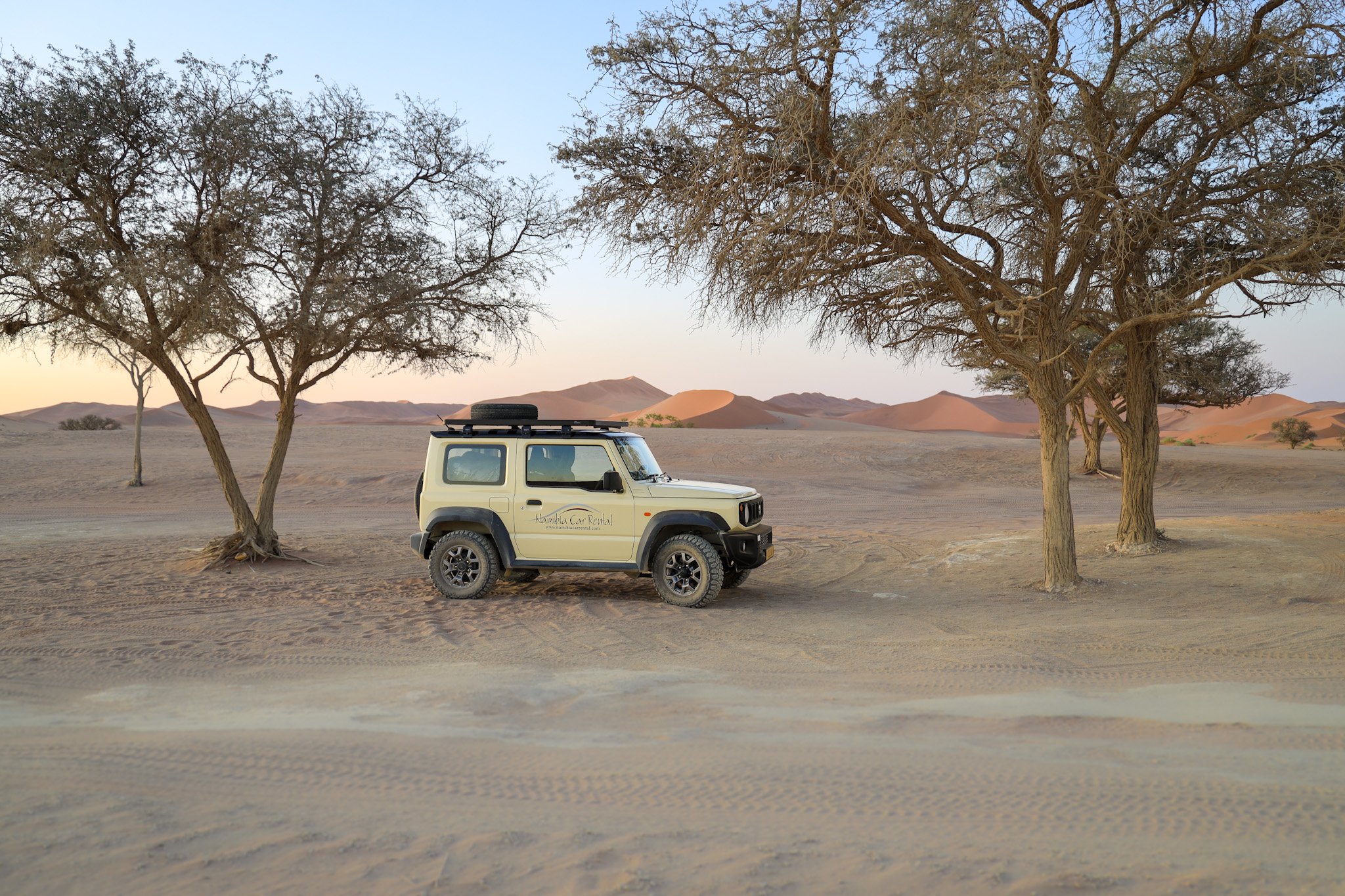
Car rental: we booked our car through Namibia Car Rental and had a great experience. We booked a 4x4 Suzuki Jimny without camping equipment since we brought out own tent. The going rate starts at N$ 736/day, or about US$44.
Gas: besides a car, the primary costs for a roadtrip will be, of course, gas. You can check the current gas prices here.
Park entrance fees: as far as we saw, all national parks and protected areas charged an entry fee, per person and per vehicle. Prices vary per park, so we recommend doing a quick search before you arrive to find the most up-to-date costs for where you’re going.
Campsites and accommodations:
We camped using our own tent throughout our trip. Almost all campsites are paid in Namibia, and almost all the ones we stayed at we booked through Namibia Wildlife Resorts, the government entity that runs tourism facilities throughout Namibia's national parks and reserves. To see all current rates for campsites or rooms, go to their resorts page (and notes prices change throughout the season). Currently, campsites run anywhere from N$150-N$700 per person per day, or about US$8-$US40. Note that nearly all the campsites are part of a lodge with room options for those who don't want camp.
When we weren't camping at an NWR site, we stayed at a few private campsites, lodges, or Airbnbs (specifically, in the cities like Windhoek, Swakopmund, Keetmanshoop, and in the Erongo Mountains). You can see all our accommodations with relevant links in our itinerary.
Food and drink: This is really what you make it. We stocked up on groceries and camping fuel at the start of our trip, and had an occasional meal at a campsite restaurant. If you're trying to budget, we recommend doing big grocery runs in the big cities (Windhoek, Walvis Bay, etc.) and picking things up at corner stores along the way, then treating yourself to a lodge meal every so often!
OUR ROUTE
There is a TON to see in Namibia, and of course, your itinerary will depend on your priorities. Regrettably, we had to cut out going out to the Caprivi Strip so we could do the Fish River Canyon Trek, climb in the Erongo Mountains and Spitzkoppe, and spend an entire week in Etosha. Depending on your priorities, you could likely make it out to the strip if you didn't opt for one of those things we did. See below for our route, in map and written form.
DAY 1
Location: Windhoek -> Keetmanshoop
Activity: Arrive; pick up rental car; buy supplies and groceries in Windhoek;
drive to Keetmanshoop (approx. 5 hours)Accommodation: Quivertree Park Camp in Keetmanshoop
DAY 2
Location: Keetmanshoop -> Fish River Canyon
Activity: Drive to Hobas (approx. 2 hours); begin Fish River Canyon trek
Accommodation: Tent camping in Fish River Canyon
DAY 3 – DAY 5
Location: Fish River Canyon
Activity: Fish River Canyon Thru-Hike
Accommodation: Tent camping in Fish River Canyon
DAY 6
Location: Fish River Canyon -> Ai-Ais Hot Springs
Activity: Finish hike and relax at Ai-Ais Hot Springs
Accommodation: Camping in Ai-Ais Hot Springs
DAY 7
Location: Ai-Ais Hot Springs -> Aus
Activity: Shuttle to hike parking from Ai-Ais to pick up car; drive to Aus along the Orange River (4-5 hours)
Accommodation: Aus Haven & Rest Camp
DAY 8
Location: Aus -> Windhoek
Activity: Drive from Aus to Windhoek (approx. 6 hours)
Accommodation: Windhoek Airbnb
DAY 9
Location: Windhoek*
Activity: Buffer day; clean gear; restock on groceries and supplies; swap rental car
Accommodation: Windhoek Airbnb
*Note: we built in these two Windhoek buffer days for 2 reasons: 1) in case we spent extra days thru-hiking the Fish River Canyon and 2) we had to return our rental car in Windhoek because we couldn't find one available for the whole month
DAY 10
Location: Windhoek
Activity: Buffer day; clean gear; restock on groceries and supplies
Accommodation: Windhoek Airbnb
DAY 11
Location: Windhoek -> Sossusvlei (Namib-Naukluft National Park)
Activity: Drive to Sossusvlei (approx. 5 hours)
Accommodation: Sesriem Campsite
DAY 12
Location: Sossusvlei (Namib-Naukluft National Park)
Activity: Explore the dunes and Deadvlei
Accommodation: Sesriem Campsite
DAY 13
Location: Sossusvlei -> Swakopmund
Activity: Drive to Swakopmund (approx. 5 hours)
Accommodation: Desert Sky Backpackers Campground
DAY 14
Location: Swakopmund
Activity: Surf lesson!
Accommodation: Desert Sky Backpackers Campground
DAY 15
Location: Swakopmund -> Erongo Mountains
Activity: Drive to Erongo Mountains (approx. 2.5 hours); rock climb at Omandumba
Accommodation: Omandumba Bush Camp
DAY 16
Location: Erongo Mountains
Activity: Drive to Camp Petite; rock climb
Accommodation: Camp Petite at Erongo Rocks Farmhouse & Camping
DAY 17
Location: Erongo Mountains -> Spitzkoppe
Activity: Morning climbing at Omandumba; drive to Spitzkoppe (1.5 hours)
Accommodation: Spitzkoppe Community Restcamp
DAY 18
Location: Spitzkoppe
Activity: Rock climbing at Spitzkoppe
Accommodation: Spitzkoppe Community Restcamp
DAY 19
Location: Spitzkoppe -> Cape Cross
Activity: Morning rock climbing at Spitzkoppe; late afternoon drive to Cape Cross
Accommodation: Cape Cross Airbnb
DAY 20
Location: Cape Cross -> Skeleton Coast National Park
Activity: See Cape Cross Seal Reserve; scenic/spooky drive along Skeleton Coast
Accommodation: Terrace Bay Cabin (NWR)
DAY 21
Location: Skeleton Coast Terrace Bay -> Kamanjab
Activity: Drive from Skeleton Coast to Kamanjab (approx. 5.5 hours)
Accommodation: Ondundu Lodge Private Tent
DAY 22 – DAY 28
Location: Etosha National Park
Activity: Week-long safari
Accommodation: Olifantsrus (Day 22), Okaukuejo (Days 23-24), Halali (Days 25-26), Namutoni (Days 27-28)
DAY 29
Location: Windhoek
Activity: Drive from Etosha to Windhoek (approx. 5.5 hours)
Accommodation: Windhoek Airbnb
DAY 30-32
Location: Windhoek -> Departure
Activity: Buffer days, explore Windhoek, return rental car, say goodbye to Namibia!
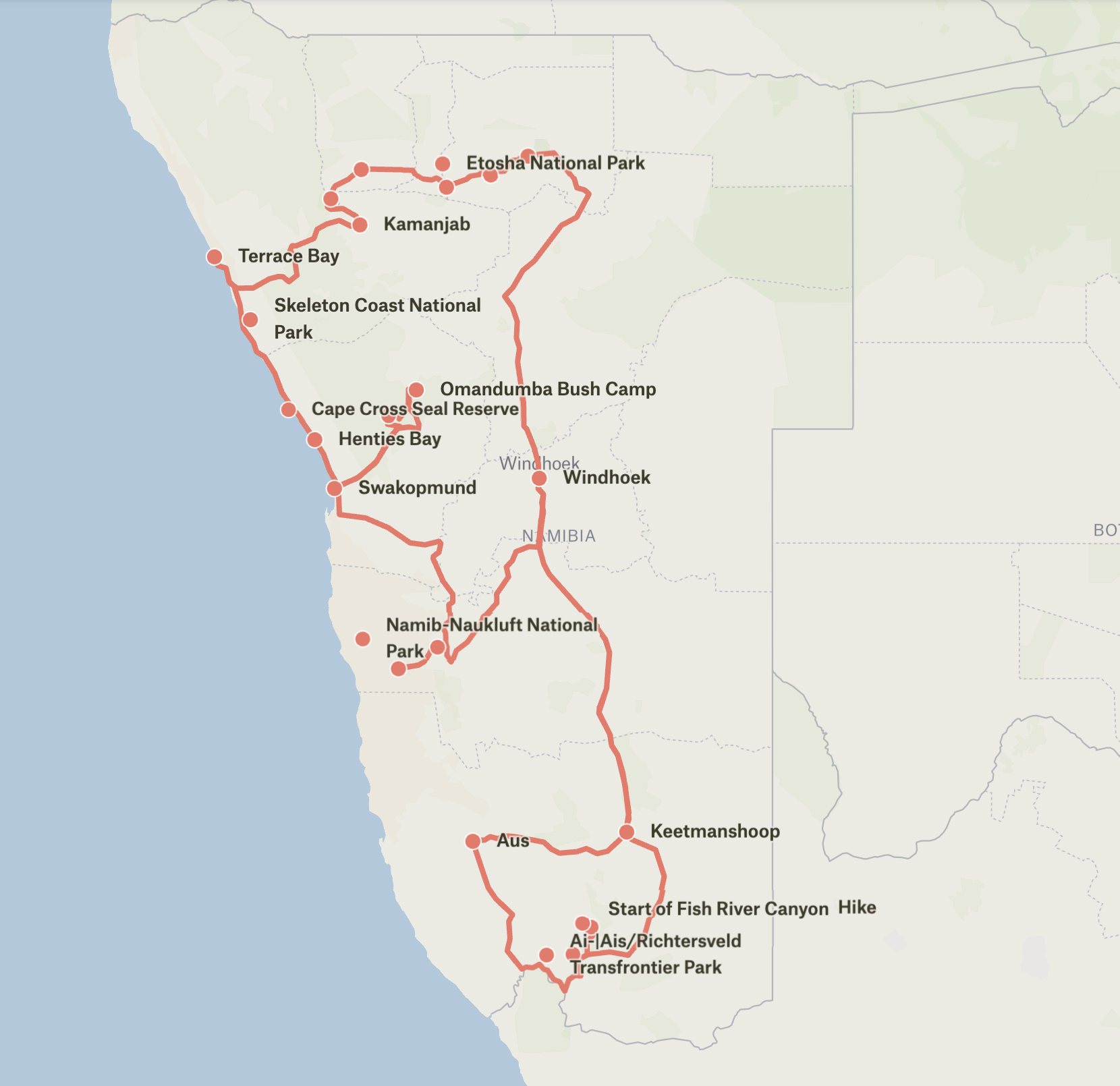
Our Namibia route — click on the map above to explore!
GETTING THERE
Almost all roadtrips in Namibia will start out of Windhoek, the country's capital and home to its main international airport. Walvis Bay, the country's second largest airport, also has international flights, but it seems they all go through South Africa (either Johannesburg or Capetown) – even flights to Windhoek! That being said, regardless of which airport you fly to, you can pick up your car rental at the airport and hit the road.
Last updated: 1 December 2025
EXPLORE MORE IN NAMIBIA


